
Steel Mineral Railway Wagons
Wartime Production
Scale Drawings for Models
This page describes the scale drawings I have available for you to produce models of all-metal railway wagons that were used to carry minerals such as coal for the commercial customers of the railway companies. The wagons on this page were built during the early stages of World War II nominally for various private owners, but immediately went into the national "pool" of mineral wagons controlled by the Minstry of War Transport. Similar wagons for other periods are covered by separate pages. This page covers those wagons with the traditional rectangular body shape, similar wagons with wooden bodies, and hopper wagons, will also be covered by separate pages.

Diagram 1/100 wagon,
Charles Roberts PO livery.
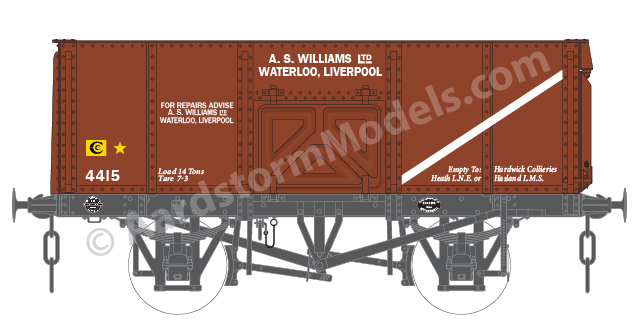
Diagram 1/101 wagon,
A.S.Williams PO livery.

Diagram 1/100 wagon,
MoT livery.
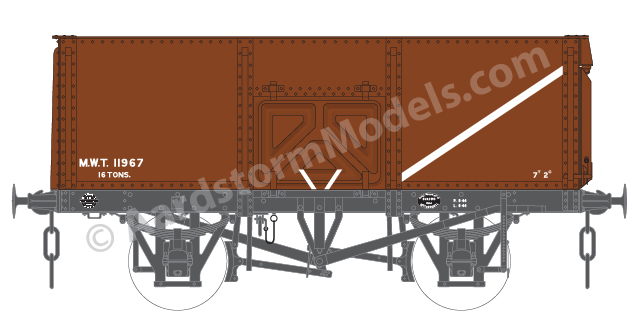
Diagram 1/101 wagon,
MoT livery.
Note: Clicking on any of the images on this page, such as those above, will cause a larger version of the image to appear in a new tab or window of your browser (depending on how your browser is set up).
The Drawings
As with all of my standard drawings, each drawing is available in a range of scales, from 2mm:1ft (N gauge) to 16mm:1ft, and most common scales in between. Once you have bought a particular drawing, you will be able to download versions of it in any or all of the available scales. At extra cost I can also provide copies of drawings at a specific scale printed onto A3 or A4 paper and sent to you by post.
The drawings will be provided as multi-page PDF files, one file for each scale. The first page in the file contains the full drawing, arranged for on-screen viewing. The remaining pages each contain a portion of the full drawing formatted for printing out on A4 or A3 paper. A drawing will consist of a number of views each showing an aspect of the wagon, such as a side, end or plan view. Where a view at a particular scale is too large to fit on A4 paper, overlapping pages are provided for you to join together after printing. Alternative pages are also provided for printing onto A3 paper.
To help with this, alignment guides are provided. These take the form of simple fine-lined crosses positioned on either side of the drawing view where I suggest a join be made – typically at a position where a minimum of fine drawing detail crossed the joint. Select one of the overlapping pages and cut it through the drawing along the guides. Carefully position the cut edge on top of the other page such that the crosses are reformed acros the joint. When you're happy with the alignment, tack the pages together with small pieces of transparent sticky tape (e.g. in the vicinity of the guides). Then use a long piece of sticky tape along the whole joint to properly join the pages together. Turn the joined pages over and add a further length of tape on the back.
For the drawings in the smaller scales (4mm and smaller), I've imposed a minimum line width (of around 0.1mm) so that the drawing remains printable. This unfortunately means that fine details amy become obscured or illegible. I suggest that you use a larger scale drawing to examine the details, and use a drawing at the scale you're working to easily transfer dimensions, or even cut up to use as templates.
The drawings for the wagons listed on this page typically contain a side view (both sides are assumed to be identical, apart from being mirror images because of the single end door), a view of each end, longitudinal and transverse cross-section views to show the interior of the wagon, and plan views of the wagon from above, as a cross-section around half-way down the body, and a plan view of the underframe on its own. Where there are major variations for a design, such as using welded or riveted construction for the underframe, two complete sets of views are provided. More minor variations, such as pressed or fabricated doors, are documented by appropriate partial views. There are also often partial views of specific details that are obscured by other features in the standard views.
As well as these views showing the construction of the wagon, I also provide drawings of the wagon in each of the major livery styles it received during its lifetime. The illustrations on the right are a selection of these livery drawings, reduced in size for on-screen viewing. The illustrations below, alongside side each available wagon type, are also selected views from the corresponding drawings, again reduced in size for on-screen viewing.
To produce these drawings, where possible I've started with an official general arrangement (GA) drawing, if not of the wagon type being drawn, then of a very similar type. From there I incorporate details from other drawings and photographs to produce a fully detailed drawing. Source drawings are often distorted or illegible in places, so unfortunately I can't claim 100% accuracy for my drawings. They should however be very close, and models built to them should look the part and require detailed examination and expert knowledge to detect any errors. A brief description of its origins are included on each drawing, so you can assess the likely accuracy for yourself.
How To Order
A single drawing costs £7.50. Additional drawings ordered at the same time cost £5.00 each. Ordering all drawings on this page as a group will cost £20.00.
Click on the buttons below to add the drawings you want to purchase to your basket. Once you have completed your payment, be sure to return to this site to receive a set of access codes for your purchases – one for each drawing and/or one for the group. These will also be sent to you by e-mail.
Enter these codes on the drawings download page here to be presented with links that you can use to view the drawing files you have purchased, and/or download them to your computer. To make downloading drawings for several scales easier, a combined "ZIP" file is also provided that contains all of the scale files for a particular drawing. Most file viewing apps (Explorer on Windows, or Finder on Mac) provide facilities for unpacking the ZIP file to access the individual files.
To order copies of these drawings printed onto paper, please first purchase the downloadable versions, as above. Then please contact me to request a quote for the printed versions, specifiying which scale(s) you want printed, and whether on A4 or A3 paper. The basic price is £1.00 per sheet of A4, or £1.50 per sheet of A3, plus postage which will also depend on the number and size of sheets required. For these drawings, the smaller scales can be fully printed on a single sheet of A4, while the largest scales can need over 20 sheets. A few sheets of A4 can be folded to fit in a C5 envelope to qualify for the normal letter postage rate. Many sheets of A4 are likely to make a C5 envelope too thick for this and require the large letter rate, so may as well be sent unfolded in a C4 envelope. A3 sheets will always be folded to fit either a C4 or C5 envelope. If you need only a few sheets of A4 and would prefer them to be sent unfolded, please specify this when you request the quote.
Copyright
My drawings are subject to copyright, and are licensed for your personal use only. You are not permitted to modify the files in any way, nor supply copies of them to anyone else, other than to get them printed by a third party. The only exception to this is where you are buying the drawings for a small group of modellers (such as a model railway club) working on a single project.
History
During World War II the then Ministry of War Transport took over the operation of much of Britain's railway network, especially freight operation. From late 1939 most common types of wagon were "pooled" together and operated under the instructions of the MWT. This included most of the mineral wagons previously operated by both railway and private owners. In principle, any wagon deemed suitable for a load could be sent anywhere in the country, potentially far from it's owner's territory. The relevant owners, railway or private, received a standard fee each time one of their wagons was used.
During this period, with the general shortages of materials and skilled labour, the production of new wagons was restricted, and had to be authorised by the MWT. As the war went on, the need for new wagons increased, and the MWT controlled and authorised their production. For mineral wagons the MWT standardised on all-metal construction, although substantial numbers of traditional wooden-bodied wagons were also constructed. Although nominally still owned by private owners, the new wagons went straight into the pool.
Production of steel wagons was dominated by a patented design by Charles Roberts with slightly sloping sides. Significant numbers of more traditional rectangular designs were also built by Hurst Nelson, Cambrian Wagon Co., Metropolitan-Cammell and Butterley. The Cambrian wagons were of the traditional 12T capacity (soon uprated to 13T). The Charles Roberts, Hurst Nelson and Butterley wagons were of the new 14T capacity (also soon uprated to 16T). The Butterley wagons were an enlarged version of their pre-war patented design.
Little is known about the Metropolitan-Cammell wagons, so I can't provide drawings. Perhaps they were similar to the wagons they later produced for the Free French Government (see below), but with normal British-style doors and fittings.
Many of these wagons were fitted with bottom doors, according to the preference of their nominal owners, so were also fitted with independent dual 4-shoe brakes. That is, each brake lever only operated the brake shoes on its side of the wagon. There was no connecting bar or other mechanism to link operation of the brakes on both sides, because this would foul the opening of the bottom doors.
The wagons produced by Charles Roberts at least were generally finished in a standardised, simple livery (probably red oxide) that included the owner's details in smaller lettering than previously common for private owner wagons. Some were, however turned out in more traditional full PO livery, especially early on and by other manufacturers.
From 1944 the MWT began ordering wagons in large numbers and retained ownership of them. They were still registered as private owner wagons with the 4 grouping era railway companies. The majority of these wagons were of the Charles Roberts design, and were built by various manufacturers, as well as Charles Roberts themselves. A batch of nearly 900 wagons was also built by Hurst Nelson to a modified version of their own design – the additional intermediate side stanchions were dropped and the wagons were fitted with pressed steel side doors of the same design as the Charles Roberts wagons, having previously possibly been of fabricated construction. The MWT wagons were finished in a standard livery of bauxite, reputedly the same shade then currently being used by the LMS.
A further large batch of 7000 wagons was built by Metropolitan-Cammell in 1944, possibly ordered by the Free French government for use in France after the war. These were of unusual design for mineral wagons by British standards, having full height cupboard doors, no end or bottoom doors and were fitted with continental-style axleboxes, buffers and other fittings. These were duly shipped to France after VE Day, along with substantial numbers of the Charles Roberts and Hurst Nelson wagons ordered by the MWT. The wagons proved to be too small for the French and were later returned to BR ownership in 1951–2.
The Charles Roberts and Hurst Nelson wagons built for the MWT were later given British Railways diagrams 1/100 and 1/101, respectively. The Charles Roberts wagons returned from France were also assigned to diagram 1/100, but for some reason the returned Hurst Nelson wagons were assigned diagram 1/113. The returned French Mertro-Cammell wagons were assigned diagram 1/112, after changing the axleboxes and buffers to British types. The other designs were not assigned BR diagram numbers.
After nationalisation, those wagons ordered directly by the MWT received the standard "B" prefix for BR-built wagons to their existing MWT/MoT fleet numbers. The wagons returned from France were also given B-series numbers. The other wagons received randomly assigned "P" series numbers, like all other private owner wagons taken over by BR. Brief details of fleet numbers are included in each drawing.
Wagon Types
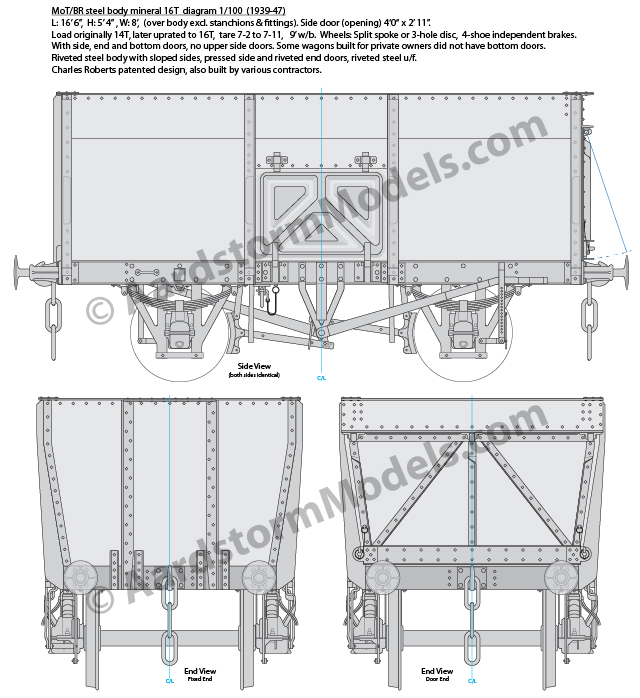
Charles Roberts design, BR diagram 1/100
14/16T, slope-sided riveted body, pressed side doors, fabricated end door, some with bottom doors.
Produced 1939–47, by Charles Roberts and later by numerous manufacturers. Some shipped to France, and returned to BR 1951–2.
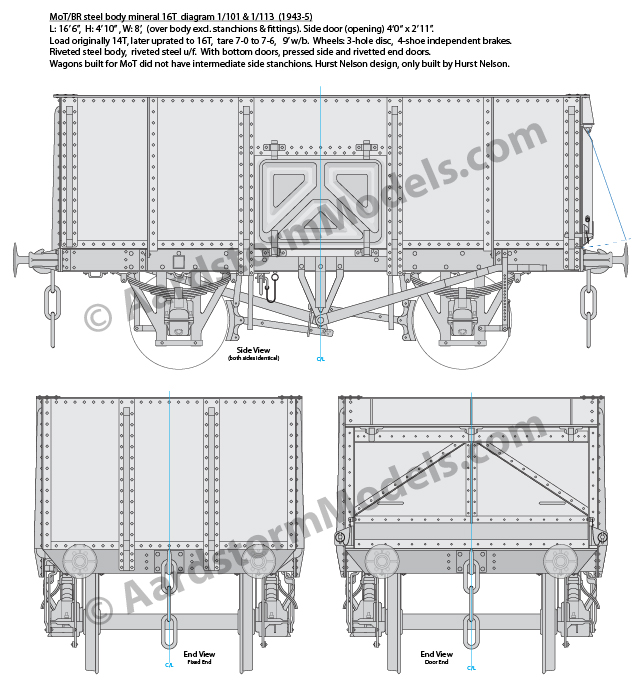
Hurst Nelson design, BR diagram 1/101 and 1/113
14/16T, rectangular riveted body, pressed side doors, fabricated end door, some with bottom doors. Wagons built for the MoT did not have the intermediate side stanchions.
Produced 1943–5, by Hurst Nelson. Some shipped to France, and returned to BR 1951–2 as diagram 1/113.
Drawing in preparation
Cambrian Wagon design, no BR diagram no.
12/13T, rectangular riveted body, fabricated side and end doors, some with bottom doors.
Produced 1939-43, by Cambrian Wagon Co.
Drawing in preparation
Butterley design, no BR diagram no.
14/16T, rectangular riveted body, fabricated side and end doors, some with bottom doors.
Produced 1939-43, by Butterley.
Drawing in preparation
French design, BR diagram 1/112
16T, rectangular riveted body, cupboard side doors, no end or bottom doors.
Produced 1944, by Metropolitan-Cammell and shipped to France. Returned to BR 1951–2, as BR diagram 1/112.
All Drawings Group
To add all of the above drawings (including those not yet available, and any added later) to your basket as a group, at a discounted price of £15:
Clicking on an image above will open a larger view in a separate browser window/tab.
Clicking on the "Add To Basket" buttons will add that set of drawings to your basket.